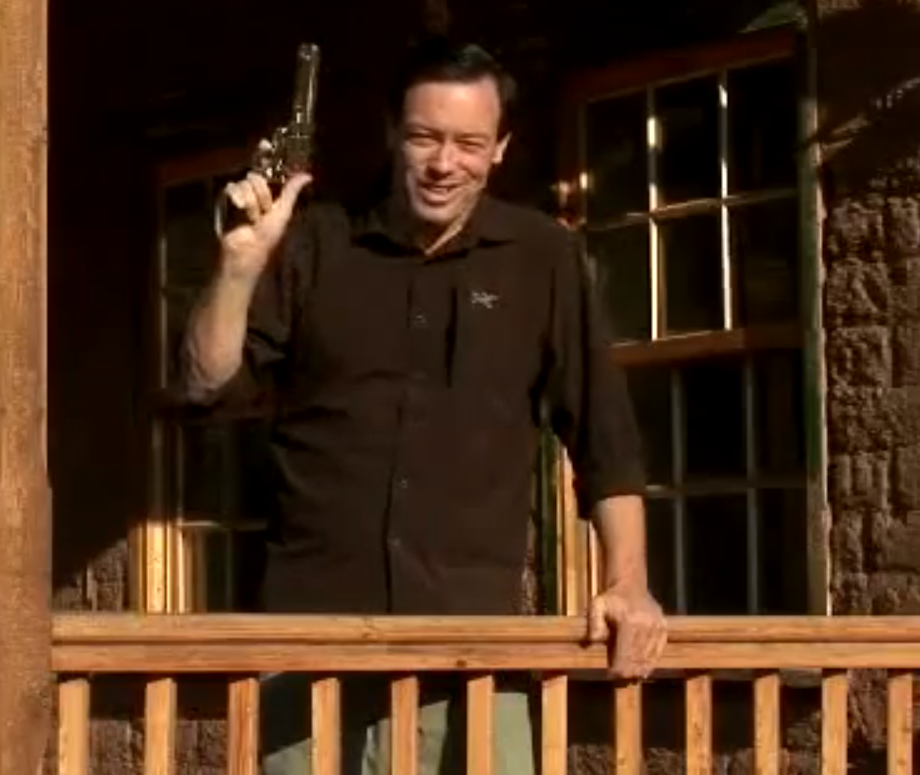
 Pleasure Unwoven is a slickly scripted and produced educational DVD presumably marketed to rehabs. I can picture a room full of rehab patients being forced to watch it right now – but hey, it’s probably better than watching videos of that priest with a chalkboard from Hazelden. I’ve digressed though – the website for Pleasure Unwoven promises:
In this DVD, Dr. Kevin McCauley explores the most important question about addiction: is it a choice? Or a disease?
…Come along as Dr. McCauley lays out the arguments both for and against the conceptualization of addiction as a disease or as a choice, and then reviews the latest research to arrive at the correct answer.
(Spoiler Alert: it’s a disease … of choice!)
Much of it (or perhaps all, I’m not sure) is available for viewing on Youtube. One chapter of it, The Choice Argument, is especially manipulative. Have a look, then we’ll discuss:
Now, my complaint is not that McCauley lies, or is particularly wrong in the above video. He is quite correct – his scenario is supportive of a choice model of addiction – but it’s also simultaneously derogatory towards and misrepresentative of the choice model of addiction.
The problem lies in the example he quite deliberately chose to use: pulling out a gun and holding it to an addict’s head. After his little demonstration he says:
that’s the choice argument’s point. With a strong enough threat I can get the addict to stop their behavior in the way that I can’t for real patients with real diseases
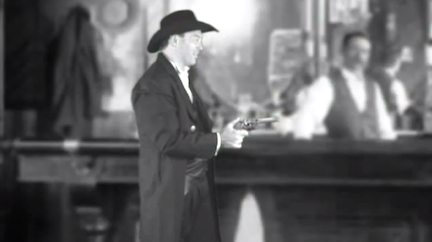 And as if that wasn’t enough, he goes on to say “They can quit if they choose to. You just have to ‘motivate them’ to make the right choice” as he waves a gun around! The point is quite clear – he’s trading quite explicitly on a false dichotomy/strawman built up for decades by the recovery culture. The idea is that on one side you have the compassionate people who recognize addiction as a disease and want to help addicts – and on the other side you have those of us who see addiction as a choice: barbaric judgmental meanies who want to threaten, punish and coerce addicts.
The reason I call this a straw man argument is simple. McCauley chose a gun and sarcastically delivers lines like “You just have to help them make ‘the right choice'” for the intentional purpose of associating the choice view with an intent to punish rather than help. Tugging at the heart strings of addicts and their loved ones with this negative imagery then makes the choice view that much easier to knock down in his victims’ minds. It wouldn’t be kind or ethically proper to chase addicts around with various threats in order to keep them from using. So it all works out exactly as he wants – McCauley remains at least technically honest in his presentation of the choice argument, and his viewers leave with the impression that a choice argument can only lead to punishment and is therefore irrelevant.
Contingency Management
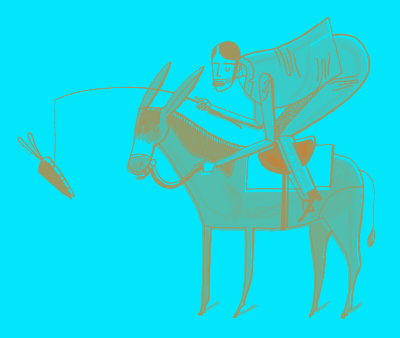 McCauley’s presentation isn’t even half the story. He could’ve chosen completely different imagery while still staying true to his western theme. Imagine this – he’s riding on the back of a burro through the grand canyon while explaining the choice argument, the camera zooms out to reveal that he’s holding a stick out in front of the burro with a carrot dangling from it – the burro keeps moving forward in an effort to get that carrot.
If McCauley was a proponent of Contingency Management (CM), that’s exactly the imagery he would’ve chosen. And unlike the method of holding a gun to an addict’s head (for which there is no peer reviewed research!), there is actually a longstanding and growing body of research on CM – which is a method of treatment in which addicts are offered incentives (as opposed to the de-centive of a bullet to the head) to stay sober. For example, addicts have been offered everything from housing and other social services to cash, movie tickets, and sporting equipment in exchange for clean drug/breathalyzer test results. The research supports the approach as effective – doubling the rate of success of conventional treatment.[1]
A gun might work as a negative motivator (or de-centive), and more modest incentives such as movie tickets may work as positive motivators, and the hope is that in the interim while the addict is persuaded by such external motivators, she just might be conditioned to live a sober lifestyle long-term. And this certainly may work in some cases.
Please Note: I Do Not Condone or Recommend Contingency Management
I’m adding this note on Dec 12, 2012: My discussion of CM data above is only meant to use the data to make a point. This should not be taken in any way as an endorsement by me of such methods. I bring this up because a few readers have made comments and email communications which showed that they think I endorse CM. I DO NOT. Contingency Management is a controlling model of help. It attempts to force judgments into the mind of the substance user. The human mind cannot be forced to think in any particular way or arrive at any particular conclusion (the desired conclusion in CM being that “I have better options than substance use”). As I already said in the paragraph below, I “wouldn’t advocate the use of the carrot or the stick as a solution for addiction.” While in a CM program, some people will voluntarily choose to believe that their other options are better than substance use, but this can’t be forced or guaranteed as a result. My preferred method of attempting to reach such conclusions is to engage in discussions and assign exercises that give people a platform in which to enlarge their range of options and accurately assess their options, and ask them to give such new evaluations a fair try. From their, it is entirely a voluntary process which must be freely chosen by the individual in order for any change to take place. I do not advocate holding a real or metaphorical gun to anyone’s head in order to force a mental conclusion out of them.
Still Not The Whole Story
Just as McCauley asserts, I do indeed look to such experiments as definite evidence that substance use is a freely chosen behavior – but alas, as a choice model advocate I still wouldn’t advocate the use of the carrot or the stick as a solution for addiction. I simply recognize the nature of addiction as a behavior people choose because they think it’s a worthwhile option, and that when it ceases to be worthwhile, or better options are recognized, the addict will choose differently. But chasing someone around with threats or rewards is impractical, and probably not the best way to get long-term results. Contingency Management is the equivalent of giving a man a fish – you end up in a situation where you need to keep giving him fish, and you haven’t helped him to find a meaningful solution to his problem – you keep him dependent on circumstances. If one chooses to expand their range of options and dares to believe that they can have a better quality of happiness with other behaviors, thought patterns, and life pursuits – then they will effectively have learned how to fish. They will create change which is internal, and nowhere near dependent on circumstances. Incidentally, this is exactly what the method I use to help people, Cognitive Behavioral Education (CBE) achieves.
NOTE: Mr McCauley, if you’re reading this, I hope you haven’t forgotten that treatment programs for pilots and doctors have made continued licensure in such professions contingent upon continued sobriety – and done so with great results. Wink wink.
[1] Contingency Management Incentives for Sobriety. Stephen T. Higgins, Ph.D., and Nancy M. Petry, Ph.D. Alcohol Research And Health, Vol.23, No.2, 1999
BEFORE YOU COMMENT (added 9/12/13)
This article IS NOT, nor is it meant to be, a full critique of Pleasure Unwoven. This article is a criticism of McCauley’s usage of the “treat em or jail em” dichotomy. This should be self-explanatory, but judging from the comment thread, it is not. So now you know. I will eventually put up a full critique of Pleasure Unwoven, and I will link to it here when I do. But for now, please know that this article is not a full critique – it focuses on one main point: that McCauley’s video is a good example of the disease theorists’ longstanding tradition of portraying their opponents as wanting to punish substance users. Keep that in mind as you comment. In the meantime, if you’re looking for an alternative perspective on the brain disease model of addiction please see this post: http://www.thecleanslate.org/myths/addiction-is-not-a-brain-disease-it-is-a-choice/

Steve, as a sister, wife and a mother of addicts I can fully say that 12 step programs work, addiction is a disease, McCauley’s video is informative and your an ass.
I think you meant “you’re an ass,” rather than “your an ass.”
Thanks!
Just stumbled across this “discussion,” got to it when I saw the headline, “Sleazy…” Somebody disagreeing with Kevin Mccauley? Gotta be a dumbass, huh? Yeah, that’s probably s’posed to have a hyphen in it, but I CHOSE not to use one…
The dumb part, well, just too easy, like clubbin’ baby seals… Yeah probably shouldn’t use that as a metaphor, somehow it seems to belong to this “discussion”
The ass part, well, I saw that error in punctuation, probably many of us did, but it would take an ass-clown (there, hyphen and all) to point it out – -what error in logic do you think has you addressing that instead of the spirit of the message?
Not even gonna address the discussion thread, just hope you ain’t (oops) damaging too may folks out there – dp
Don Peters, CDC, M.A. (ABD), M.S., Ph.D. Candidate, D.O. (dog owner)
Yeah, lotta letters, huh? I think my business card has so many degrees on it it’s trying to be a thermometer rather than a–never mind, that joke’s never been as funny to others as it is to me – d
stevie takes the position of an academic, positioning himself firmly in the precise middle and wondering why he’s so uncomfortable.
The gun/scene is just to show the one form of “recovery” and the addict’s response. The “meat” of the article is completely ignored. The need to retrain the brain is addressed and addressed in other publications he has written.
Steven, it is always interesting to note how critical people can be of things they claim to understand but have not the credentials commensurate to whom they are criticizing or critiquing. I have not noticed your credentials nor how you can intellectually and medically argue one way or another with any level of competence. You will notice the comments of others and the initials after their names and their opinions are based on experience, years of erudition not suppositions.
Dr. McCualey’s postulates and conclusions are in line with what we now know of the brain and how it works. His behavior model is upi and running with enormous success. We can now recognize the magnitude of what an addict is facing but moreover an explanation how how in the world they would make the decisions they do and the behavior they exhibit. We can also help map out a plan of recovery based on the best knowledge we have at the time. Intrinsically, this makes total sense when looked at from an objective point of view in the experience of addiction. A ship my friends and members of my family and I were on for several years.
Start with a Clean Slate and argue from a sound medical/behavioral standpoint and avoid looking foolish and incompetent to the rest of us.
Dr. M Alan
Bravo Doc! Encore please!
Love ya Steve,
Matt
Dr M Alan,
I am embarrassed for you, because even I, who painfully lacks initials after my name (and before my name), know that an appeal to authority as you have just made, is not an argument. Have you studied logic 101? In case you don’t realize how you did nothing more than appeal to authority, let me quote you:
That’s what you attempt to persuade me to shut up with? That there are people with “initials after their name” who claim addiction is a brain disease? I can cite plenty of people with “initials after their name” who do not think the brain disease models of addiction hold water. Here is a list:
Stanton Peele PhD
Sally Satel MD
Gene Heyman PhD
Jeffrey Schaler PhD
Marc Lewis PhD
Alva Noe PhD
And there are more, but please investigate the work of these individuals before you walk around pretending that every ‘credentialed’ person with “initials after their name” is on board with Mccauley’s point of view. You don’t want to look “foolish and incompetent” now, do you?
Do you want to get into an appeal to authority pissing match? To me, it seems a little silly, because of course fact isn’t discerned or established by a vote, popularity, or prestige. We couldn’t determine whether addiction is a brain disease by counting how many elite individuals believe it or not. We can only determine it by logically analyzing the pertinent information. So, it strikes me as hollow for you to come here and assert that I have no idea what I’m talking about while backing up this assertion with nothing more than an appeal to authority and a questioning of my authority.
I have presented some detailed arguments on what I believe to be the holes in the brain disease model of addiction. Incidentally, my most popular article in which I tackle this issue has recently been published in the same textbook on addiction of which an earlier edition featured an article by Mccauley. Popularity and being published doesn’t make me correct, but maybe you could take it to mean that my argument on the brain disease model of addiction is at least worth considering. Maybe you’d like to read it, and punch some holes in it You can do so here: http://www.thecleanslate.org/myths/addiction-is-not-a-brain-disease-it-is-a-choice/ – I invite you to tear it apart on its content, in a sound way rather than just dismissing me out of hand because I don’t have ‘initials after my name’ – i.e. attacking the messenger. You’d look less foolish if you did so.
And if you enjoy tearing that one apart and find yourself able to argue “with any level of competence”, I’d also invite you to take a stab at my article regarding the sort of neuro-reductionism that these brain disease claims rest upon: http://www.thecleanslate.org/philosophical-brain-disease-addiction-epiphenomenalism/ Again, you’d look less foolish if you addressed the issues rather than trying to humiliate/stifle/socially intimidate me by highlighting the fact that I don’t have “credentials” or ‘initials after my name.’
For the record, I think my experience and number years “in recovery”, working professionally to help people with this problem, and studying the issue of addiction is comparable to Mr Mccauley’s experience. I’ve simply gone about it in a different way. I am co-author of the latest edition of The Saint Jude Program, which has an independently verified 62% long-term abstinence rate. And I’m sure I care as much about the problem and helping people with it as Mr Mccauley does. I do not question his motives – he obviously genuinely cares and wants to help. However, I think his vision of addiction and how to help people with it is wrong, and I think the way that he argued against a choice view of addiction was fallacious, because it was an emotional appeal meant to set up a false dichotomy between the disease view as compassionate and the choice view as punitive and heartless. I find this insulting; and though he’s not the only one to use this false dichotomy to win converts, he has provided a striking example of it which I chose to highlight here.
-Steven
I kind of like what you said, but I can’t stand that elitist position you use in the beginning.
“…the nature of addiction as a behavior people choose because they think it’s a worthwhile option, and that when it ceases to be worthwhile, or better options are recognized, the addict will choose differently.”
Wow. I’m sure you have some data or reasoning to back up this statement. It took thirty years for me to progress from trying my first beer at 15 to seeking help for the first time at 45, and while I understand that anecdotal evidence is of little value, I can assure you that for many years I tried and failed to “choose differently”. It was not possible for me to choose in a meaningful way, as I was unable to act on my choice.
My only qualifications for the statements I’m about to make are that I have struggled with substance abuse, and I am a person who has always stressed the importance of attacking questions such as these with both a lack of bias and an abundance of common sense. It actually astonishes me that so many people subscribe the the disease model of addiction. A disease is a condition you catch, typically by no fault of your own…addiction is the predictable result of an individuals series of CHOICES to ingest too many dangerous substances. Certainly ones environment and life experiences factor in, but the fact of the matter is that drinking alcohol, taking a pill, snorting cocaine or using a needle require that a person make a self determined physical action on their own accord. You could argue that in progressive states of addiction, especially when dealing with substances that induce withdrawal, the person has less of a say in the decision to use, but it wasn’t that way from day one?!?! For the most part, we know exactly what we are doing and the potential consequences. I read an article by McCauley where he suggests that the real meat of the disease argument can be seen in the “phenomenon” of craving, which can overcome the best intentions of the strongest people. Fair enough, but people don’t just wake up one morning with the compulsive urge to shoot heroin in their veins. Craving is the result of a series of choices the individual made in the past. Obesity is the result of an individuals choice to consume excessive amounts of unhealthy foods with limited to no excercise…well defined muscles are the result of an individuals choice to lift weights…addiction is the result of an individuals choice to ingest an excessive amount of dangerous substances. To reframe the predictable outcome of a series of choices as a disease, is categorically absurd. The fact that success rates of AA and most treatment centers are abysmal across the board, might lead one to believe that the core of their teaching, the disease model, is fundamentally flawed. But I guess the treatment industry is so lucrative, that, at this point, those that perpetrate this nonsense are acting in the interest of self preservation…kind of like an addict disregarding reason and ethics to get their next fix.
My feeling, as a recovered addict, is that yes, early in life we make choices – as teens, often choices to try drugs and alcohol. I simply believe that we somehow enjoy the effects more and generally tend to indulge in far more that most young people “experimenting” with drugs. I could drink more than my friends from a really early age. I didn’t see it as a choice, but I do believe I was chasing a feeling that many others either did not feel, or did not have the desire to feel. I chased the “change of state”. Perhaps addicted to feeling different, if that’s possible. Normal did not seem interesting, exciting or something to strive for. I have watched too many good people who truly wanted to be clean and sober die to believe addiction is a choice. The only true choice would be to never indulge and even though my children have all the information, and parents in recovery, they are choosing to experiment. The hope they will be the exception to the rule – but in the end, I don’t think they will have a choice, except to not indulge. Addiction is a progressive disease – just as diabetes and cancer and heart disease are. No one becomes an addict overnight and no one dies of cancer when the first abnormal cells develop. Nor does a diabetes die with the first ingestion of sugar. It takes time, but they are all diseases.
You leave out genetics or propensity to become addicted. Fair enough the addicted person has to choose the substance in the same way many people contract diabetes with a bad diet, or cancer from smoking. I didn’t know we were discussing who’s fault the disease is, I thought the focus was on the most effective treatment options and understanding the disease itself. If addiction is solely due to “choosing” to take the substances into the body and brain, why do millions of people drink alcohol heavily without the same inability to stop or control it once acted upon while another 1/10 feel obsessively driven to keep doing so despite negative consequences or missing out on material “incentives”?
Dr. M Alan,
While your extensive vocabulary is impressive for an MD, the problem is that this argument does not require a degree…basic human common sense is enough to determine that calling the product of deliberate, un coerced choices a disease is nonsense. A child could deduce as much. Before you get so caught up in the opinions of “experts”, keep in mind that in 1633 you and your brilliant experts would be chastising Galileo for suggesting that the earth revolved around the sun…in 1491, you would be mocking Columbus for suggesting the world is round. In other words, it’s easy to hide behind credentials and follow the crowd…it’s admirable and courageous to call bullshit when you see it. Grow up bro.
Kevin Baker, MBA
Would diabetes or heart failed or cancer or a mental illness be such a controversy. no because they have been classified as a real disease so is alcoholism. You want to talk about sensationalism look in the mirror. Everyone wants a bandbox to stand on and your one of them
I’m an alcoholic and pleasures unwoven is the best documentary I’ve seen
Did you get your degree from a matchbook???
Dr. McCauley’s description of “craving” is the best I’ve heard. Which is his basic argument against the “choice argument.” Does his description of the dopamine hypothesis change the historic or current effectiveness of CBE? Yes, I’m being rhetorical. I guess my point is that, while it’s interesting to study the causes of addiction, the solution(s) are much more important.
Dear Mr Higgins thanks for your comments and structures regarding Dr Mcaluley,s explanation of addiction like our good doctor I am an alcoholic in recovery.On first seeing the dvd while in treatment It went a long way to explain simply why I could not control my addiction and meant a lot to me personally. Having struggled for years too understand why I had no control over my actions was a relief. If you have never experienced going to a shop counter asking for a packet of cigarettes then asking for a bottle of vodka that you don’t even want!! then then you should take up the bottle and experience it for yourself it takes around ten years of hard drinking to get their (so I look forward to your findings in ten years time) tell pray do what choice as an alcoholic do I, and countless thousand,s of alcoholics out there have now you have experienced it for yourself?
kevin’s movie suggests the addict is only capable of exercising real choice when sober. the brain chemistry sections explain why an addict’s capacity for choice is compromised. even to the extent of second guessing the threat of death, just to get his fix.
i don’t see the logic of seeing the gun metaphor as a reflection of the ‘stick’ approach.
the ‘choice’ advocates are not helping addicts by attributing to them the capacity to make correct choices when provided with the right incentives. they are setting up addicts to fail, and to see themselves as having failed. this negative emotion only perpetuates the addicts negative view of themselves, which itself promotes hopelessness and further self abuse.
the central theme of kevin’s movie is that addiction is a disease of choice. it explains this assertion within the parameters of the accepted disease model, by showing how the physical organ of choice and the chemical processes that cause the impairment of that organ (the relevant part of the brain) work to create the impairment.
the so called pro choice argument misses the point. staying sober is a choice that can only be made when one is sober and both subject and her support system (friends, society) have to understand the real physiological barriers – the disease – that needs to be treated to get the desired outcome.
steve, i feel your stance is tacitly underpinned by an illinformed and judgemental position with regards to addicts. i don’t feel you bring anything positive to the discussion about addiction. your efforts to appear sympathetic and positive about helping addicts ring false.
perhaps you should ask yourself why you are resistent to the disease model of understanding addiction. and why you are so sensitive about being accused of being a ‘punisher’ of addicts. the gun metaphor has absolutely nothing to do with you or the pro choice camp. you’ve utterly missed the point. now ask yourself, why you did.
Did you actually watch to the end? He is describing a perception about addiction, which he then critiques. Describing something is different from endorsing it. I find your criticisms quite bizarre.
Hi, did you actually read the article you’re critiquing? I watched the full video, and then correctly identified McCauley’s rhetoric as containing a straw man argument. Do you know what a straw man argument is? It’s when you portray your opponents position inaccurately so as to knock it down easily – hence the name “straw man” like a scarecrow, a hollow flimsy lifeless man unable to fight back. I FULLY understand he’s not “endorsing” the position that we should be holding guns (literal or figurative) to the heads of addicts to make them stop using – but my point is that he’s pretending that those of us who endorse a choice view endorse such a thing. That’s why it’s so sleazy, because he and the other disease model proponents get to swoop in and be the nice compassionate guys versus the big ol punitive meanies. GET IT???? DID I NOT EXPLAIN IT ENOUGH IN THE ARTICLE OR DID YOU JUST NOT READ IT??????????
Really, are you kidding me? Kevin’s video is awesome. Very helpful to addicted individuals and their families. I show it all the time. Go pick on something else. How negative can you be? Go stimulate your brain by doing something good and noble, like Kevin. Yeah!
Hope Steve Slate has finally watch the whole DVD in context. Points taken out of context are very misleading about the DVD. Anyone who is interested in the truth, please obtain and watch the **full video** (not excerpts) and read Kevin’s McCauley’s post August 11, 2012 at 5:25 PM in the comments . I watched the whole DVD last night and it helped immensely in understanding brain-wiring. I think there is merit with multiple treatment avenues given a persons’s physiology. Please also look at Dr Daniel Amen’s work as well. It is important to become self-aware and take responsibility of choices…this includes understanding brain-wiring *and* what help is out there for those who have crossed the line Dr. McCauley mentions. As others have said, one-size doesn’t fit all.
“Steven Slate says
June 14, 2013 at 1:53 PM
It seems like you’re here to attack me without even addressing the point that I’m making in the post. Did you even read the post?
As to the question of whether I’ve seen the entire video – **I do not own it, and I do not know what comes in the full package, although I have seen the 9 or 10 chapters of it available on youtube.”**
Do you have an actual argument with points that I have made here? Or not?
If you’re accusing me of getting something seriously wrong by missing the context, then please EXPLAIN IT SPECIFICALLY, instead of just vaguely asserting I’ve gotten things wrong.
We are not here to educate you Stevie. You stuck your neck in this noose and now you are a little nervous.
Ed – it’s not about educating me – it’s about a basic foundation of debate. If you’re going to make a claim, then try to support it in some way. I can debate what is presented, I cannot debate against “you’re wrong” or ad hominems. That’s how children, and grown up idiots debate.
What I never see pointed out is that the disease concept (of addiction or anything else, i.e. hypertension) is A concept, not the only concept. Technically speaking, only medical doctors can treat something with the disease model (usually by prescribing medications or performing surgery) which they first diagnose as a disease. Of they cannot diagnose it, they cannot treat it. It makes perfect sense that Kevin ascribes to the disease concept, he is a doctor. As a licensed counselor, it is illegal for me to treat people with the disease model (practicing medicine without a license). So I have to use something else. BTW, once it becomes “addiction” it is not truly a choice either.
Greetings
I am a person in long-term recovery.
The postings so far are interesting. I have a perspective that addresses addictive behavior. When we are born, we are entitled. As we mature, that sense of entitlement may or may not diminish. When it doesn’t, we behave from the stance that “I can do whatever I want, whenever I want, for as long as I want, with whom or to whom I want, and you can’t stop me.” AA calls this stance one of “being self-centered and selfish in the extreme.”
As a marginal member of AA, ACoA, CoDA, and SLA, for more than 10 years in each case, having attended over 1000 Anonymous meetings, after committing and serving a five year probationary sentence for a felony offense, earning multiple degrees, spending thousands of dollars on psychological services, reading a hundred or more self-help books, becoming a Peer Recovery Coach, working as a SMART Recovery Facilitator for three years, and living 68 years, fear is not a qualifying motivator to recovery (or for correcting most any anti-social behavior), in my experience.
The behavioral change jury is still out on the disease/not disease issue pertaining to addiction. My experience and my observations indicate that addiction is a complicated issue with no pat answers. To argue the disease issue is to miss the point of recovery. No one recovery path is right for every person seeking to stop acting, thinking, and believing in addictive ways. Just as any one person may have multiple addictions and just as there are endless combinations available to us, it is not rational to believe there is only one pathway out of addiction nor is it rational to believe that there is only one perspective on how to approach recovery.
As long as we think either or, we will suffer tunnel vision when it comes to finding our own way and/or supporting others along their journey to healing. My encouragement to those seeking answers in the realm of addictions and healing.
Blessings
N.H.
Thinking addicts will recover with “material incentives” is hopeless. Just as any addict that constantly self-sabotages all their opportunities! While Kevin is truly helping addicts, loved ones, the medical and psychological fields, government, to understand addiction as a real disease so that it may be understood and treated, you’re merely a critic promoting your CM philosophy and going against preventing true education and help for addicts, their loved ones and society as a whole.
Why don’t you publish the success rate and numbers of your ridiculous “incentive philosophy” against the powerful and life changing results of 12-step programs and see for yourself how they stack up?
I personally spent more than 6 years of my life in prisons for bad deads done to feed my addiction with no help offered for the disease in those institutions and i deserved that “punishment” and to “pay my debt to society”. In my opinion, society also needed to be protected from my bad choices and actions. But I knew in my heart I never “intended” or “set out” to become an addict or to hurt anyone.
Through the spiritual principles and practice of the 12- Steps, combined with the focus on seeking God’s power and will for my life rather than my own selfish ambitions I’m able to treat my addiction on a spiritual level and stay clean and sober, one day at a time.
Those 12 steps are summed up as “Trust God, Clean House, Help Others” (synonymous with Biblical principles of “surrender all to God and his control, repent, and love others in action”, just broken down in practical instructions and actions for doing so, with the love of others that have demonstrated it working in their own lives.
By the grace of God and the 12-steps and fellowship (12-steps can be applied to virtually any character defects” I treat my addiction on a daily basis and stay clean and sober.)
The following I don’t put out to brag or say it’s what all addicted will realize through the program, but I could have easily spent the rest of my life behind bars in a hostile environment that did significant damamge to psyche for which I also had to seek recovery and healing after being released. Since I was released in 1998 and began my spiritual journey, I have achieved rigorous honest and character, earned the trust of my loved ones with which I have wonderful relationships today, and instead of being a detriment to society I’ve been able to become a successful and honest businessman with a GED earned in prison and a net worth of approx 35 Million today in completely honest businesses starting only from just $85, one set of clothes and nobody to help upon my release (I paid $7 a day to stay at “Salvation Army Homeless Shelter” while I worked various low paying jobs to be able to save enough to share a run down trailer for $50 a week” and work my way up. I’ve made restitution for all back taxes owed over the years of my addiction (plus significant) interest and penalties and have since paid millions of dollars in taxes as a productive part of society, as well as supporting numerous charitable organizations that I believe really help others. Further, I’ve dedicated the vast majority of my net worth to charity and helping others rather than pursuing selfish ambitions and luxury living. Finally, have shifted my primary focus from acquiring more money to spending my time dedicated to helping others, wanting and expecting nothing in return.
The point is, a man who was broken, sometimes suicidal, dishonest, utterly hopeless and a burden to society found hope, healing and real life-transforming power in God as I was able to “experience” God through the recovery and guidance of those in 12-step programs that showed me undeserved love and direction through their own recovery success, expecting nothing from me in return other than to carry the message of hope and healing to those still suffering.
I can tell you for me, Kevin’s video “Pleasure Unwoven” taught me more about my disease and my own behavior than any other literature or videos I’ve ever found, and multiple self-paid trips to treatment centers in my quest for help and recovery. I did not want to be an addicted person with bad behavior, but I simply didn’t know how to change it!
For anyone suffering with addiction, trying to understand the addict/alcoholics behaviors and seemingly loveless and irresponsible actions, or those in the medical, psychological, spiritual, treatment or governmental sectors that really want to make a difference in suffering people’s lives, both addicts/alcoholics and their victims in society, the video is a MUST SEE!
Bottom line is it’s factual and extremely educational. It shines a light on reality and truth rather than opinion and bias and has the potential to educate others properly lending to very positive and powerful change in otherwise hopeless people’s lives. I applaud Kevin for his dedication and accomplishment in bringing this education to all and his desire to help others by giving back from His own recovery and 10 years of dedicated and research to find the truth for himself, and share it with those that want and need it.
Critics that write articles out of selfish ambition and promoting their own unproven philosophies by discrediting others (like Kevin) that are really making a positive change
will one day answer to God for misleading and impeding others in need from getting to the solutions that are PROVEN to WORK. Just go visit any open 12-Step meeting and listen to the stories and struggles of those addicted and see what God has done in their lives, then compare that to the other, generally money motivated “philosophies”.
James 3:1-2 “Not many of you should become teachers, my brothers, for you know that we who teach will be judged with greater strictness.”
I pray for all those still suffering from addiction, their victims and our society to become educated properly with powerful resources such as “Pleasure Unwoven” to help treat this horrific disease with the remedies that really work and are proven over decades and God’s Love and Power demonstrated in the lives of millions of alcoholics/addicts. There IS hope and healing to be had. Kevin’s video brings hope and understanding as a building block for broken and seemingly hopeless situations. just like many other diseases, no matter how or when contracted, there is “medicine” that can arrest (not cure) the disease. But we have to understand how to treat the disease of the brain and not the symptoms of the disease, which Kevin brilliantly and simply educates about for the better understanding of all. A “Disease” is medically defined as an “organ that has a defect that causes symptoms.” For those seriously addicted the “organ” is the brain, that has a “defect” and results in “symptoms” (feeding the addiction despite repeated negative consequences and the bad behaviors and choices that result from doing so). There is currently no “medicine” to heal the brain from this defect. For some medical conditions the best “medicine” is not a pill but an action, such as purposed exercise or diet. There is no pill or surgery to remedy the defect in the brain that is addiction. However, there is proven “spiritual medicine and action” that are proven to arrest the disease and transform otherwise hopeless lives! There is specific education and action offered in the 12-Step programs that works, as made available from God.
Finally, this recovery “spiritual medicine we take by action” is not for those that need it or even those that want it. Most addicted do! It’s for those that are willing to learn about it and work at it, but not alone, with the help and guidance of others that suffer from the same disease and have learned how to overcome it and have realized the transforming power in our own lives.
The solution is in God as demonstrated through the 12- Steps of recovery and/or other spiritual solutions with the healing power of God. You may not like it, but that’s just the fact. Myself and millions of others hopeless and sick people are living proof! If you can offer up living proof in millions of lives that have recovered from your philosophy, I’m open to listen…
I pray for those still suffering, both inflicted and affected, for God’s healing and will for our lives and the power to carry it out”