I’m constantly referencing this study in my writing, so I figured I should post up the main information from it here. The study is an analysis of data from 2001-2002 National Epidemiologic Survey on Alcohol and Related Conditions, or NESARC for short. This data is relevant because it comes from a survey representative of the US population as a whole – unlike many addiction studies which only survey people who go through treatment programs. Those studies often find that people relapse quickly without continued treatment, leading to the erroneous assumptions that addicts can’t quit without treatment, or that addiction is a chronic disease, and especially that abstinence is necessary and that successful moderation is rarely attainable – among other nonsense. But what we find when we broaden our scope, like in this study, is that the majority of people with Substance Dependence (as defined in the APA’s DSM-IV) actually quit on their own without any sort of treatment or 12-step involvement. Here is the most important table from the study, so you can look at the numbers yourself:
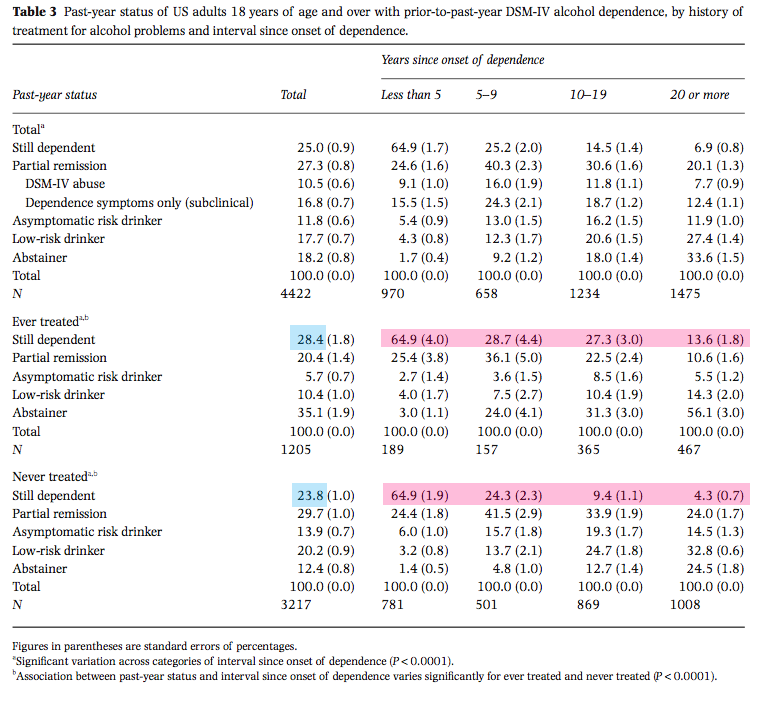 It’s important to realize that this is representative of the general population. They are questioned about past substance use and diagnosed with the DSM-IV criteria for Substance Dependence. This study proves a few key points that directly contradict the common knowledge about addiction:
Point #1: Most People Cease to Be Substance Dependent
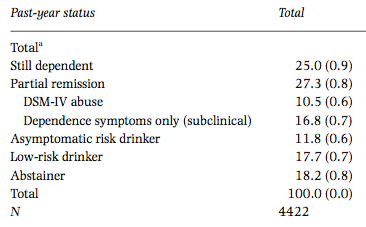
The fact is that at any given time, of people who could be classified as Dependent in a time prior to the past year, only 25% of them are still dependent. That leaves the other 75% as no longer Dependent. This one fact proved by this study offers a lot of hope for those with substance use problems. The odds are that you are three times more likely to end your addiction than you are to continue your addiction! We know this from the data above and in Figure 2 (shown to the right).
Point #2: You Have A Better Chance of Ending Your Addiction If You Are Never Exposed To Treatment Programs or 12-Step Programs.
The study breaks the total group down into those who have received treatment (including 12-step group involvement) and those who haven’t ever received treatment. If you look at the numbers I highlighted in blue on the table above you’ll see that 23.8% of those who were never treated are still dependent – yet 28.4% of those who have been treated are still dependent. This means your chance of resolving your substance use problem may be better if you simply avoid treatment!
The recovery culture claims that you cannot end your addiction without treatment or 12-step meetings, but the facts show that a higher percentage of people end their dependence without ever getting this kind of “help”. Moreover, in raw numbers, most people stop without treatment. If you look at the table you’ll see that the total number of people participating in the study is 4,422, of which 1,205 have been exposed to treatment, and 3,217 have never been treated. That means that in this study, 2,451 people ended their dependence without treatment, while only 862 ended their dependence with treatment. Another way to express this – 73.9% of those who end their Substance Dependence do so without treatment!
Point #3: Long-Term Success Is More Likely Without Treatment
If you look at the numbers I highlighted pink in the table above you’ll see that they represent success rates at various intervals since onset of dependence. What this means is when we look at the first number, for example, we learn that 64.9% of people who have received treatment, and whose addiction started sometime in the past 5 years, are still dependent. The interesting thing about this is that the number is exactly the same for untreated individual whose addiction began in the past 5 years! So in the early years, there is no difference in outcome whether you get treatment or not! The numbers stay close for people whose problem started 5-9 years ago (with the untreated group doing slightly better), but when we get to the group whose substance problem began in the range of 10-19 years ago we start to see a massive gap between the the treated and untreated subgroups – at this point we see that only 9.4% of the untreated group are still dependent, while at the much higher rate of 27.3%, those who attended treatment and 12-step meetings are nearly three times as like to have been dependent in the past year! What does this say about your long term chances of success in the conventional recovery culture? This group is no anomaly either, when we get to those whose problems started 20 or more years ago we see the untreated group doing great with only 4.3% still dependent, while the treated group is now doing more than 3 times worse with 13.6% still dependent.
The recovery culture has advocated longer and longer stays in treatment, to the point that they’re now telling people to mortgage their homes to pay for a full year of inpatient treatment, and then coming up with all sorts of “aftercare” plans for out patient treatment, sober living houses, long-term pharmaceutical treatments, and a lifetime of 12 step meetings. Meanwhile, the facts are the facts, and the numbers above prove that they should really be advising us to stay away from treatment for the rest of our lives, if we want long term success. But if you want a life of “recovery”, maybe you should stay in treatment.
Point #4: Moderate Use Is A Possible and Probable Outcome For Resolution of Substance Dependency
In the table above, the groups of numbers directly below those highlighted blue represent non-abstinent recovery from Substance Dependence. A large number of people fit into this gray area where they are drinking, but not to a threshold that qualifies them as addicted. The categories are defined in the study as follows:
Five categories of past-year status were used in this analysis:
1. Still dependent: had 3+ positive criteria for alcohol dependence in the past 12 months.
2. Partial remission: did not meet the criteria for alcohol dependence in the past 12 months, but reported 1+ symptoms of either alcohol abuse or dependence.
3. Asymptomatic risk drinker: past-year risk drinker (see definition above) with no symptoms of either abuse or dependence in the past 12 months.
4. Low-risk drinker: past-year drinker with no symptoms of either abuse or dependence and who was not classified as a past-year risk drinker.
5. Abstainer: did not consume any alcohol in past year.
People with PPY alcohol dependence were classified as being in full remission in the past year if they were in categories 3, 4 or 5. They were classified as being in recovery if they were in categories 4 (non-abstinent recovery, i.e. NR) or 5 (abstinent recovery, i.e. AR).
It should be mentioned that the Partial Remission category has a relatively low threshold, in that respondents may fit the category by reporting only one symptom of the DSM-IV Substance Abuse and Substance Dependence criteria – i.e. – if you drink, and you have an argument with a family member about drinking – then that would be a “symptom” of Substance Abuse, and you would be considered to be in partial remission. But who’s to say the fact that you got into an argument with a family member means that you are anywhere near “dependent” on a substance? Many in this category could be safely considered moderate users.
Also, you should know that “Asymptomatic Risk Drinkers” are those who didn’t have any symptoms of abuse or dependence, but drank at these levels: for men- drank more than 14 drinks per week on average or had 5 or more drinks in one day at least once in the past year. For women – drank more than 7 drinks per week on average or had 4 or more drinks on a single day in the past year. Notice that you don’t even have to drink every day or drink the 7 or 14 drinks per week, you can be considered an asymptomatic risk drinker in this study if you have one day of somewhat heavy drinking. So – pop open five beers over the course of a 4th of July picnic, or finish off a bottle of champagne on New Year’s Eve, and bingo, you’re an asymptomatic risk drinker.
I bring all this up not to criticize the study, but only to show that the lines in between “Still Dependent” and “Abstinent” aren’t so clear. What is clear, is that there are a large number of people who fall between these two poles, and thus a large number of “moderate” drinkers. This is important to realize, since the recovery culture doesn’t allow for moderation as a success story – they believe it’s abstinence or nothing, and in fact they actively teach people that once they’ve been Substance Dependent, a single drink will rapidly escalate them back into full blown substance dependence. The facts show that this clearly isn’t the case. Moderation is possible, and indeed a probable outcome for people experiencing DSM-IV Substance Dependence.
The numbers also suggest that the all or nothing message of the recovery culture is a powerful one – for better or for worse. The percentage of abstainers in the treated group is nearly 3 times that of the “never treated” group (35.1% vs 12.4% respectively), which some may look at in isolation, and declare that treatment is clearly successful. But, with 28.4% still dependent, the path of treatment produces nearly 20% more failures than the path of no treatment (23.8% still dependent). This is not shocking, when you consider that those who attend treatment are taught in no uncertain terms, repeatedly, that a single drink will lead to a complete loss of control over drinking. Likewise, the “never treated” individual has less exposure to the all or nothing recovery message that a single drink will lead to full alcoholic breakdown/relapse, and accordingly, more of them fit into the area between the 2 poles of dependency and abstinence. When we sum up the 3 middle categories (2, 3, & 4 on the list above), we see that 63.8% of the “never treated” group fit into the middle, while only 36.5% of the treated group fit into these middle categories. While the all-or-nothing message may push more people towards abstinence, it may also push more people towards full blown Substance Dependence. Furthermore we may interpret the subcategory data relating to time since onset of dependence as evidence that the all-or-nothing message delays progress, as I discussed in point #3 that in the long run, as we look at people who are further and further away from the time when their substance dependence started, the percentage of treated individuals who are still dependent (13.6%) is more than 3 times higher than the percentage of “still dependent” in the never-treated group (4.3%). They start out with identical success rates, but over time, the untreated group clearly does better – what happens in between for the treated group is debatable, but I believe the all-or-nothing message sends them on a roller coaster ride between periods of struggling to painfully hold onto abstinence one day at a time, followed by explosions of full blown “addiction”. Were they able to accept a something in between these two poles, they might just live and learn, and get to a happier life free of Substance Dependence sooner, as the never treated individuals seem to do at a better rate.
Some may take issue with my further interpretations of this data, and they may have legitimate points, which is why I posted the table for you to look at and judge on your own, and cited the source below. The basic point though, I believe holds strong: most people recover from substance dependence, with or without treatment.
Source: Recovery from DSM-IV alcohol dependence: United States, 2001–2002 Deborah A. Dawson, Bridget F. Grant, Frederick S. Stinson, Patricia S. Chou, Boji Huang & W. June Ruan Laboratory of Epidemiology and Biometry, Division of Intramural Clinical and Biological Research, National Institute on Alcohol Abuse and Alcoholism, National Institutes of Health, Bethesda, MD, USA
Does this say anything about 12-Step based help?
Yes, it absolutely does. A later paper by the same author about the same date broke down the kind of help received by the treated group. Of that 25.5% who sought help for their alcohol dependence, they included:
3.1% who had participated in 12-Step programs only, 5.4% who had received formal treatment only and 17.0% with both 12-Step and formal treatment. Based on the most appropriate model, help-seeking increased the likelihood of any recovery [hazard rate ratio (HRR) = 2.38], NR (HRR = 1.50) and AR (HRR = 4.01).
So 20.1% attended 12-step meetings, and only 5.4% went to treatment without also attending 12-step meetings. That means approximately 80% of the treated group attended 12-step meetings. Surely, these results apply in some way to the effectiveness of AA. What’s more, approximately 80% of treatment programs use a style of counseling called Twelve Step Facilitation, which promotes the teachings of AA, and most other substance dependence counseling methods employed in formal treatment programs also involve teachings from 12-step programs. So it’s safe to say that the rest of the group who didn’t attend AA meetings were nonetheless taught the principles of AA while in treatment.
The majority of the treated group was definitely indoctrinated with the 12-steps of Alcoholics Anonymous.
SOURCE: Estimating The Effect of Help Seeking on Achieving Recovery From Alcohol Dependence.
Limitations (section updated Oct 17 2012)
This study doesn’t give us all the answers, but it’s one of the most solid pieces of information we’ve got in the world of addiction. There is plenty more information I’d like to know, but this is still enough to draw some very important conclusions from. With that said, there are limitations I should make you aware of in the interest of open debate. It doesn’t count people who are currently institutionalized i.e. prisoners. Nor does it account for deaths caused by substance use.
The deaths point is important, because many people bring that up as a big gotcha when discussing these figures. However, I recently attended a talk given by Stanton Peele at NYU where he mocked the claim that deaths account for what appears to be success among the untreated population – he wrote about this in one of his HuffPo columns:
The research led the NIAAA to announce its discovery that “alcoholism isn’t what it used to be,” reversing decades of the NIAAA’s forceful adherence to disease and abstinence memes. Meanwhile, the NIDA’s National Survey on Drug Use and Health shows that peak abuse of and dependence on drugs and alcohol occurs from ages 18 to 25, and declines by a third after age 25, and by half after age 30.
…Meanwhile, how many times have I heard harm reduction people account for the decisive fall-off of substance abuse with age: “Why, they all die!” (One in 10,000 people in this age group dies per annum due to drug overdoses, which occur mainly for older abusers.)
I liked Stanton’s point, and he linked to the CDC as his source for the 1 in 10,000 number for that age group: link.
Also, a new study out of Germany on alcoholism mortality rates concludes that treatment makes no difference in the mortality rate of alcoholics:
Annualized death rates were 4.6-fold higher for women and 1.9-fold higher for men compared to the age- and sex-specific general population. Having participated in inpatient specialized alcohol dependence treatment was not related with longer survival than not having taken part in the treatment. Link
So much for the claim that the success of untreated alcoholics over time is a mere illusion created by their rapid death rates! In light of this, we need to wonder whether the absence of data on prisoners may be just as insignificant to the analysis of this study.
The results discussed above are for alcohol users. What about drug users? NESARC provided data on that too. “Recovery” from “addiction” to other drugs is highly probable – even more so than from alcohol. I give all the statistics on probability of recovery at this link, and citations for the data. Unfortunately, the researchers haven’t given us the same sort of comparison between treated and untreated groups. With that said, alcohol and illicit drugs affect the brain in similar ways, they are used for the same reasons, they effect people’s lives in the same basic ways (with the exception of the illegality of drugs and the extra consequences that imposes), quitting drugs or alcohol is achieved in the same way, and both addictions are “treated” in the same way professionally (except for the exceptions some make in separating drug addicts from alcoholics in an attempt to preserve the fragile egos of some alcoholics). Furthermore, at the time of these studies, only about 20% of people with drug addictions received treatment. Yet the overall recovery rates are still high, in fact higher than the rates for alcoholism (the currently recovered rate for alcoholism is about 75%, and for drugs it is about 80%). So, although NESARC hasn’t yet given everything I want in a study, I feel safe concluding that the same basic principles apply across substances, given the current information.
For those who would dismiss the data because they don’t know exactly how much treatment the treated group received, I would say this: show me the treatment that gets a better than 75% long term success rate, and then we can talk. Even Hazelden, the gold standard of treatment, doesn’t claim a higher than 60% success rate, and personally I think that claim is bunk, since I’ve called and asked for supporting documentation on that claim more than once and they’ve refused to provide it (and by supporting documentation, I don’t mean that I want to see their surveys, records, etc – I just want to see what their criteria was and how they came up with that number – yet they offer nothing but the number itself).
THERE IS NO WRONG WAY TO STAY SOBER!!!
***THERE IS NO WRONG WAY TO STAY SOBER!!!!
No wrong way to stay sober? Really?
I used to say (and not having finished SJR’s JT Home Program, when I fully expect to be a kinder, gentler MAN!):
“Alcoholics aren’t a**holes because they’re alcoholics. They’re alcoholics because they’re (we’re) a**holes!”
Simply stopping or curbing substance over-use doesn’t fix the problem. ‘Quitting’, by itself — regardless of 12- or a gillion-steps, coping ‘skills’, CBT and its many iterations, and ‘therapy’ of ANY kind — is ONLY maintenance and a continuing, self-held belief in a sick, disabling gene or DNA or etcetera!
By merely quitting, w/o addressing and fixing the True Problem (immature CHOICES!), only the outlying, apparent and more obvious symptoms of the True Problem are ‘solved’. Immature choices for immediate gratification — rather than mature choices for a delayed and sustainable happiness — will still abound . . . in abundance! (Accounting for a 12-stepper usually or only having ONLY other steppers as ‘friends’.)
AA, CA, NA, etcetera, ‘therapy’ and ‘treatment’ are, and always have been, nothing more than band-aids. (Pay attn to Baldwin Institute’s disclosure of the REAL research, and not the simple & lovely & warm & fuzzy anecdotal ‘evidences’.)
In other words: The immature a**hole, in us all, even after substance abstinence — and WITHOUT SJR — will CONTINUE to live on and on and on.
I say this, trying not be an a**hole, but because I care for us all, and because I care so much!
Hey Buzz,
Excellent!
It appears you have snatched the pebble from my hand grasshopper.
Thank You, tommyD. Even grasshoppers need encouragement, but not too much, or like a politician if you vote for ’em, will only keep talking and stumping and, eventually, lie.
Buz.
PS. I’m actually a frog. (Short story, not now.) When I was 10-yrs-old, I used to hunt grasshoppers in my yard; shoot them with a mini bow & arrows made from a bent and color-thread wound bobbi-pin and end-notched toothpicks; coat them with chocolate and eat ’em as snacks!
Yet, your grasshopper reference put a Sincere, Thankful, and Very Needed Smile on my face this AM!!!!
PS. tommyD . . . it appeared to me that your “NO WRONG WAY TO STAY SOBER!!!!” comment was not pro SJR or Steven Slate’s dialogue.
If so, you are to be Commended! for not parrying with a Shaolin Kempo countermove, and with an open and Truth seeking mind & heart, heard what I was trying to say.
That was obviously not your only pebble!
thx buz
I completely AGREE with you! When you are involved in a 12 step program, you must identify yourself AS AN ADDICT, which, causes you to think about it DAILY, and skews the way you actually see yourself. First of all, no matter what drug you have been or still are, addicted to, everyone is MORE than ONE THING! Identifying yourself as an “addict” on a daily basis makes you FOCUS on that alone, which is absurd. I speak from personal experience, having been in AA for 5 years, over 20 years ago. And like most “12 steppers” all of my friends were the same. And although the program is not supposed to judge, they are people, and treat those who relapse like children instead of the adults that they are, which causes relapsers to not come back after 2 or 3 “relapses,” creating the mentality of the person who relapsed that he/she is a “loser,” “inadequate,” “hopeless” etcetera. I will say, and I don’t give a s**t about the lashback from saying so, that AA, NA are brainwashing programs, that once you leave, and go back months or years later, you see it VERY clearly. They say in meetings, once you “go out” you rarely come back and that’s true, not because you can’t or haven’t beat your addiction, but because you see it for what it is.
I agree with so many portions of your comment. As someone who has bought the NA party line for 23 years and am now questioning everything I was “taught” in the rooms, am finding that now, when I verbalize those questions, I am told that I am in my disease or chastised for talking bad about the program. I have been struggling with the addict label and I feel like it only separates me from others. I have come to the conclusion that we are all searching for the same thing, which, in its simplest explanation, is connection, and the only thing that differs is the ways that we try to obtain that connection. To continue to label myself as an addict and refer to everyone else as “normal” is sending the message that I am abnormal and, as I’ve always believed, what I focus on, expands.
Brilliant Katherine and a brave thing to say …. you are not an addict – you are no different to anyone else … you made bad choices … not because you are bad but because you didnt have the skills at the time ….
chris
good job Faith, Perfect. ***** Stars
Good job BUZZ perfect way to put it , if you say it like it is, most will believe. Its up to the individual to understand it’s up to them to reach down deep inside themselves in order to have a simpler control and quit blaming others. You sure can tell the difference between the established AA and the ones who want a better choice in life. Thank you
What is the SJR ?
Unfortunately you only know enough about the fellowship of Alcoholics Anonymous to make inaccurate assumptions. By ASSuming Alcoholics Anonymous is only a Band-Aid and does not treat the underlying problem is completely incorrect.
I have been a substance abuse counselor for the past 18 years and have been drug and alcohol-free for 29 years. With that said, I have my doubts about the current system of recovery we have in place. While I see addiction as a health related issue I do not necessarily believe that the 12-step program is the only answer for recovery and I agree that there is a percentage of substance dependent individuals that recover spontaneously. I see this as a deeper issue and had some of my reasoning validated by the book “Chasing the Scream”. I do believe that the biggest intervention for a substance abusing individual is connecting to society. Currently, most of the world is bent on disconnecting and shaming individuals by locking them up for long periods of time. The recovery rates have not changed dramatically through the use of incarceration, treatment, and 12-step programs. We also now have an industry that develops and sells evidenced based curriculums and ignores research that could cause a paradigm shift in how we view and treat addiction. I believe our current system of incarceration and treatment is ineffective and costly. We need a paradigm shift in the addictions field so that we are effective and helpful.
Paradigm changes have been around f-o-r e-v-e-r.
It’s been awhile since I Googled the math, but it took CENTURIES for the last country (the Netherlands, I think, in the 17th century) to accept that the world is round, following the ‘discovery’ that it is, around 350BC. (The exact dates & country may be different, but the Truth of this is FACT! If anyone wants to debate, Google it, yourself. Then, we can . . . talk!)
So, NEEDING more — then all — people to go from where they (we) are; to getting a clue; to accepting; then IMPLEMENTING change, takes — it seems — F-O-R E-V-E-R!!!!
So, what’s a body to do?
Talk.
And TALK about SJR!
All the time.
Evidently, we’ll just have to wait for the dinosoars to die off, while WE CONTINU
I have to say I’ve been going to Al-Anon meetings for several years, in which AA members also attend as ‘double qualifiers’. I’ve heard countless stories of success in beating the addiction to drink by following the steps. I don’t believe these are anecdotal stories – the evidence is sitting in a chair besides me! So the statistics are nice, but numbers can be manipulated, polluted and otherwise mismanaged to say almost anything we want. There have been literally millions of people who have found new lives via the 12 steps. How do you argue against that? And I’d like you to clarify something about the disease: are you saying addiction is a result of a character or personality disorder, and not due to genetic or other disease-like causes? If so, you are bucking a LOT of experts in the field, both medical and psychological. I’m not a brainiac nor an expert by any stretch, and I’m not a addict, so I may be speaking above and beyond my right to do so with authority. But I would like to follow up with a personal question: how many people (including yourself) do you know who have successfully ended their addiction on their own? And how many of those can casually have a drink or a hypodermic full of heroin “just for recreation” and not have a problem craving it again?
I personally know quite a few people who have quit on their own. And I have personal experience with the fellowship, 24 + years clean. Again the steps are one way but not THE only way. For those who chose that route, great for them; but for others who choose another route, and it works, that’s great also. I also know many who have left the rooms and have taken a drink and have had no ill effects to their lives, now I can’t say the same for heroin use but not sure if that is a great comparison. Maybe, those people who have taken a drink and have not suffered ill effects, were not truly “addicts/alcoholics ” and they just needed an interrupt in their lives while they placed other things in their lives that gave them more meaning than the drugs or alcohol ever did. Not my place to decide for them whether they are or aren’t and also, for those that did end up taking a drink, it is also not my place to label them as getting loaded/living dirty or any other label that we, in the fellowship, use to differentiate us from them. There is no us and them, it is only us and there are many paths, so take the one that works for you and, at any time, change paths if you find a better fit.
You go girl. I have been in recovery over 30 years and respect the 12 steps as having aided me. I DO NOT identify as an alchoholic any more than I dwell on being a sinner. I am a delivered child of God who loves others and knows we ALL have stuff to get over and dependencies that are not drugs and alcohol. Who’s perfect…? No one. We all fall short and that’s ok. God loves us anyway!
can’t stop laughing Buzz on point.
Paradigm changes have been around f-o-r e-v-e-r.
It’s been awhile since I Googled the math, but it took CENTURIES for the last country (the Netherlands, I think, in the 17th century) to accept that the world is round, following the ‘discovery’ that it is, around 350BC. (The exact dates & country may be different, but the Truth of this is FACT! If anyone wants to debate, Google it, yourself. Then, we can . . . talk!)
So, NEEDING more — then all — people to go from where they (we) are; to getting a clue; to accepting; then IMPLEMENTING change, takes — it seems — F-O-R E-V-E-R!!!!
So, what’s a body to do?
Talk.
And TALK about SJR!
All the time.
Evidently, we’ll just have to wait for the dinosoars to die off, while WE CONTINUE TO
Paradigm changes have been around f-o-r e-v-e-r.
It’s been awhile since I Googled the math, but it took CENTURIES for the last country (the Netherlands, I think, in the 17th century) to accept that the world is round, following the ‘discovery’ that it is, around 350BC. (The exact dates & country may be different, but the Truth of this is FACT! If anyone wants to debate, Google it, yourself. Then, we can . . . talk!)
So, NEEDING more — then all — people to go from where they (we) are; to getting a clue; to accepting; then IMPLEMENTING change, takes — it seems — F-O-R E-V-E-R!!!!
So, what’s a body to do?
Talk.
And TALK about SJR!
All the time.
Evidently, we’ll just have to wait for the dinosoars to die off, while WE CONTINUE TO T-A-L-K and EDUMACATE outside ‘normal’ education circles.
Circular & self-supporting, just like us and OUR SJR, is a little like a football game: Competitive. We just have to believe — accept! — that WE know theTruth, as opposed to merely having an opinion. The ‘culprit’, here, is not us against ‘them’. It’s us against the Buddhist & new-age indoctrination that there are no absolutes; only opinions.
Keep the faith, Baby, in Absolute Truth! As Jesus once said (and, not that I believe everything the bible says that he said), “For those who will to know the truth, the Truth WILL be made known to him [ . . . then to her].”
Totally agree. Rehabs CAN work, but their success rates are far lower than what they state in their brochures. Ideally, it’s up to the addict to find what works, and options should be freely offered and available.
Most rehabs don’t keep or offer any statistics on their results.
And those that do skew them to exclude many people in their programs, for example someone relapses (which they tell people is a normal part of the disease) and then kick them out of the program and keep their prepaid money, are not counted as they use phrases like “60% of our clients that complete our 90 day program” so they don’t have to count the ones that don’t make it that long.
The rehab industry is a scam.
You are not well informed on how most treatment centers work. I’m an A&D counselor at a residential facility and have 9 years of sobriety. The treatment center I work for is one of the most revered in the country, as is our owner. Never once have I heard or said “relapse is a normal part of the disease.” Nor have I seen someone kicked out of treatment for a relapse. We’re human, and if we’ve used substances as a solution to the problem of dealing with life, when that solution stops working, we need someone to help us learn how to handle this problem without the desire to run to [insert addiction here]. I stopped using drugs and drinking pretty early in my life, and have since never had to pick up a substance to medicate my problems away. I have, though, suffered a grueling fight with a love and sex addiction that almost took me out two years ago. Hey, guess what, I’m now recovered from that addiction and I achieved that through 12 steps as a PART of my recovery. If you’ve never spent 24 hours a day thinking about and craving something… be it a drug, alcohol, sex, relationships, gambling… and have had all other measures failed, and still wake up thinking about the [insert addiction here], you’ve no right to judge AA or any other 12-step program. Have you lost a family member to addiction? a friend? a friend’s family member? Have you ever seen addiction up close? The reality of addiction and how UGLY and lethal it is?Have you ever watched someone waste away on a substance without any kind of success outside AA? I have. It took my father when I was 9 years old, it took my best friend 10 years ago, and one of the most beautiful souls I know this past October. I’ve had friends whose family members have shot themselves in front of them because they couldn’t handle the pain anymore. I have scars all over my legs and hips from cutting myself in an attempt to let out some of the pressure addiction has held me with. Have you ever seen an arm full of track marks? or seen a heroin addict completely break down because of their complete hopelessness and desperation? I have, and I’ve experienced that complete hopelessness and despair. I went to treatment and started working the 12 steps, and though I’ve continued to see these things, I’ve never had to be that person again- the person I was before I put down substances. The only success I’ve found to work for me is the 12 steps I’ve incorporated into my life through Alcoholics’ Anonymous. This is where I found integrity and self-worth. So, unless you’ve seen it up close and personal or personally experienced it, there is no right to judge.
J
Yessssss !
The source you list for your argument says the opposite of what you say in your article. Below is a direct quote from the article you list as a source – Dawson et. al. (2006) Estimating the effect of help-seeking on achieving recovery from alcohol dependence.
“Individuals who participated in 12-Step programs in addition to formal treatment had almost twice the chance of recovery and more than twice the chance of AR compared with those who received formal treatment alone.
CONCLUSIONS:
Help-seeking plays a significant role in the achievement of abstinent recovery from alcohol dependence, with 12-Step participation playing a major role. Appropriate model selection is critical to assessing the impact of help-seeking.”
Absolutely. He said it himself that it’s a survey of the general population. And research by NIDA shows that about 1 in 9 has a substance use disorder. So his stating that 25%remain dependent is actually a higher rate than the national average. This article is just fuel for people to continue to try to stop and many times the results are horrific for them and their families .
I sought help several times, stayed abstinence for a time, sometimes longer sometimes not. Being involved in 12 step programs just put me around people who reveled in the drama that addiction provided for their lives, the majority not “working” the steps. I used substances to hide from inner turmoil that was eating me alive. With a history of molestation, physical abuse and having buried a child when I was still a child myself drugs gave me a safe zone where I didn’t keep beating myself up, blaming myself for all I had been through. When I sought help I thought there would be someone, a trained therapist, to LISTEN to me but instead I was just shoved some pills to “make me better” In years of help seeking not one counselor has ever heard my story or taken the time to LISTEN. I at least met one counselor that let me write a brief synopsis of my story to share in group. Her reaction was to say “wow! I understand why you use” It was the first time I felt like someone heard me. Making someone believe in themself is a strong “medicine” I didn’t want sympathy or prescriptions, I just wanted someone to help me believe in myself and learn to trust. The idea that I was powerless against a substance didn’t make sense to me until I realized that I wasn’t powerless until I let drugs take me to the non thinking place in my head where I didn’t have to feel, as painful as things can be, I finally realized that the pain itself can be healing if someone is there to guide you through it. I also learned, unfortunately, that while I was in the number zone I was a target for abusers and partook in activities that made me want to just remain numb. I had to really learn to believe that I was NOT powerless to succeed, it wasn’t easy but the struggle was worth it. After 10 years of sobriety, I sought treatment for depression because I still remain my own worst critic and I felt I should be over my pain. When I went to a counselor I was honest in my pre-evaluation survey and admitted to my extensive history of substance abuse. What I got from the counselor was “we need to work on your substance abuse problem before we address anything else” What a bunch of horse shit. I’ve been “clean” for 10 years, I have no desire to use, I want help with the demons left behind that still stab my ego with self doubt and loathing, but when I stated this I was told I was in denial and given numerous prescriptions. I had to pull out all the strength I had and overcome my depression alone because there was no help. I have been told by many that I am a smart, competent, strong individual but I still do not see it, I just do what I have to to make my life functional and give love to the ones who love me instead of disappointment there are so many studies about what trauma and abuse do to the brain but it seems that no one is willing to put the work into actually helping. Where are the trained ears that provide guidance? I have yet to find a single pair. I cry sometimes for the others out there that share my pain and don’t have the strength to prevail against all odds. 12 step programs made me feel like there was no hope for me unless I gave up and became powerless, if I would’ve believed their be I’d be dead by my own hand long ago..I am a survivor and a warrior. I am currently working on my masters degree in professional counseling so I can be the ears for someone who needs to dump their destructive garbage. It is my goal someday to open up my own center of intensive treatment that teaches people to believe in themselves and take back the power to face their problems, suffer through their pain and move on. If you let the trauma live on inside you and surrender to its destructiveness, you essentially just throw a blanket on a fire…it may go out, but it may set the blanket ablaze and consume you. The real goal of treatment should be to seek out why you use in the first place and then fix those issues. I believe that most people would discontinue their self destructive behaviors if the root of those behaviors were dealt with. I’m not saying I know the answers, I’m just saying there has to be a better way.
As per SJR (in my opinion & in my brief history with it): our ‘problems’ are the result of our attention on our problems and, specifically, our immature use of immediate gratification to resolve — temporarily — the pain and suffering of, what I believe is, self-torture.
Focusing on our ‘problems’, in the hope that understanding it/them will somehow resolve, is what schools teach then, through our reliance on the ‘experts’, we parrot.
And, thus, the Truly unsuccessful vicious circle and cycle continues.
True, many have become abstinent with 12-steps & treatment coping skills. But, alcohol, drugs, and the many other ‘things’ are just things: symptoms of . . . what?
Symptoms of an inability, through lack of maturity, to take our attention OFF of our problems — while recognizing that we ‘have’ them — and focus instead, maturely, on the solutions. That is, to ACT maturely as a WELL person, not as one who requires coping skills to resist a sickness, even a temptation.
It really is quite simple once traditional education, and it’s treatment models, is seen for what it is: self-preservation, and the protection of a culture that will support its ignorant, ‘though educated, non-sense.
Steve,
have you seen SJR help PTSD, with or w/o drug & alcohol use?
I currently believe that PTSD — just like “alcoholism” & “addiction” — is seen as an assumed cause. I also, currently, believe that it is more accurately an affect that is fed by our belief — focus & attention — in and on it.
As such — if I’m even close to being right — it only stands to reason that SJR and its CBL are a Perfect Solution!
I can understand a lot of the angles on how people feel about a 12 step based recovery. I have tried therapy, cbt, moderate using, etc. My understanding of AA is that it is a last resort, for people who have tried and failed at everything else and would be considered by addiction specialists as a “hopeless case”, I am in no way surprised that lots of people are able to stop, moderate, or whatever they choose to do and lead happy successful lives. However for myself it seems to be the only thing that works. I have been in the mindset of screw AA its a cult as well, and tried too moderate on my own but it would always end the same for me, gradually ending from smoking pot/ drinking with friends to shooting dilaudid and crack in a matter of months. I do still feel like treatment programs are money grubbing bastards, I think it is a straight up business and the sick things they said to my family to keep me in when i had received all the information they had to offer were just disturbing. “One more month here could save his life, a funeral would be more expensive” being the worst.
But at the end of the day for myself, I needed AA. I know all of the background of AA, the fellas who started it were certainly not saints lol Bill was cheating on his wife, and using morphine the whole time he was “sober”. Anyways, nothing else worked and believe me I tried every other way because I definitely was not a fan of AA lol now im doing well in there, have a good group of friends who are not insane AA thumpers, and just lead a more thoughtful principled life, which I could not do when I tried to moderate my usage. A lot of healing has occurred and I have grown up a lot through the program and help from family, just basically growing up, and sometimes wonder if I could handle using recreationally again, but the risk of ending up back where I was, for myself, outweighs the benefits of having a beer or smoking a joint with some friends. It just is not that big of a deal to me to have a glass of wine with dinner, or whatever else anymore. Why risk all I have gained for something so insignificant, the desire to do that just is not there anymore I guess.
Dude your killing people with these posts. Some suffering addict might read this and think they can stop on their on. You say addiction is not a diease, but the United States medical society says it is. Jails, institutions and death. That’s the result of a sick addict without a recovery program. Parideim shift? Maybe cancer and AIDS are too or maybe you should ask the people that are dying of it what they think it is that makes them sick. You are killing people with this post how’s that for a parideim shift?
I was severely addicted (&co-dependant) to smoking cocaine for over a decade. I decided to change my life and proceeded to do so ALONE. I decided I had power. I decided my mind would be the boss of my body from now on. Nothing would cross my mouth or body without my MIND deciding over it. I made my mind stop taking orders from my body.
nope. addiction is not a disease for most people. it might be for some, but i know more people who have stopped on their own than those who have with AA. AA sets most people up for failure, as it emphasizes the amount of days so much that the second they have a couple beers, they feel that theyve failed, and will tell themselves that they might as well go all out. the guilt that hangs over their heads from smoking a joint or getting a little drunk makes them want to start shooting dope again (ridiculous to me). also, the people around them dont help AT ALL. AA is full of drug addicts who look down on those who dont need the program, and treat others like kids if they dont agree with everything in the program. they try telling you that they are open minded, but that is a huge lie; they are extremely judgmental. my friends who are part of aa have relapsed many more times and arent doing as well as those who decided that they needed to change their lives because their old actions made them disgusted with who they had become and the lives they had to live because of drugs. that is exactly how i am, and i know for a fact i will never relapse. i hear my friends in the program talking about having tough days, or that its difficult to stay off dope, or that they were triggered, and i dont have that issue one bit. not once have i even considered using dope in the last year since i got clean, even on my worst days, because i know that im happier like this than on the streets. nothing will ever get me to use heroin or meth or crack again because i view it as a disgusting thing that has stolen 5 years of my life. i am beyond disappointed in myself for losing those years, and wish i had never stepped up from occasional coke sniffing to daily injections of heroin, and almost daily of either meth or coke. i do not surround myself with people who are prone to relapse, which is what you will be around in aa, and i know that has helped. my buddies i talk to who are in the program always end up relapsing with somebody else who they met in rehab or aa, and im glad that i chose to get clean on my own. im living with my cousin who was also an addict, but has the same mindset that i do about it. he is disgusted that he ever did that shit, and has never been better, even than before he ever started getting high. my friends (and myself) who have gotten clean on their own are all doing much better than those who use the program. we do not see everyday life as a struggle. we do not look at ourselves as powerless victims. we do not find every little excuse we can as a reason to get high. those are things that people in aa have to worry about, and ive seen more progress in myself and my friends without the 12 steps than with them. i am not a “dry” addict either. i have changed many things about myself that have helped me stay off drugs, and i will continue to do so because i see how much more i enjoy life this way.
In the rehab where I work the emphasis is on understanding yourself, knowing why you don’t want to be in your head, accepting and honouring the pain from childhood. I am a psychotherapist and I focus on the “knowing why” a person does drugs. 99.9% of all of our clients have trauma from childhood which, in my view, leads to not wanting to be in your head hence the use of drugs or alcohol. And unless those issues are dealt with the addict continues to be vulnerable.
I agree with you 99.9%. My personal story started in childhood trauma’s. Drugs (of any sort) where only one of the ways I tried to cope with adulthood without having responsible parent’s as a child. Until I found a way to deal with and accept the lack of a loving and caring childhood, I was unable to deal with my use of outside sources to placate this loss. Once I made a decission to heal from the trauma’s of child hood my “Drug’s” were unacceptable to me. Many well meaning people hampered my progress. Until I began to use what I could from the well meaning people I was unable to progress. I used their labels without internalizing them. I called my self an alcoholic, but never to my self. I accepted I would lie to them about this label and told myself the truth about it. I got a sponsor. A sponsor is a label lie A.A. uses. The sponsor does not sponsor. I did the steps, found a few truly “recovering” people to use as support. I moved on keeping the sponsor and few support people willing to help ME. I then began the process in ACA using a similar method to get what I wanted. I now have 4 members of my support group from three different programs. They do not know each other and function as a “sponsor” to ME. I also use a few people from a church also. All in all I cobbed together a program that works for ME, and I don’t worry about them. I am happier, healthier and freer than I ever have been.
Tony A., 1978
the reports of my illness grew out of his illness thus the reports of my death were an exaggeration. Mark Twain
Dear Mister Fulton
Your story…thanks for sharing. I feel this…can’t stop cry because finally somebody
who understands..and express what i go through un a bit similar way. My strugle keeps going on 25 years… I have to say i am okay but its like you say with the blanket on fire. There is a combination in me…BUT the main cause is still a little unconcsiense (protection) trauma but its the root and probably THE solution for letting loose of selfsabotage. and the fact i like drugs and alcohol..but its killing me softly. I am also seen as a strong person..people say just stop using and everything will be ok..temporarily Yes. But No for the longterm..I feel understood but i will not give up. Next year i go to an ashram for 6 months..maybe it can clear my damaged ego or i dont know how to deal with it. I wanna let it sleep but i agree what you say.and go through the pain but how?
Dear mister: i really do not expect an answer(i seek myself) to an answer on post 5 years ago..You are not alone and i am not alone . So, strange telling this😃 I hope you are having a good life!! You touched me with your beautiful soul and brave heart. Sorry for my English..Its difficult to express difficult “things” The world needs people like you .
Some people in AA use the word disease erroneously. Our literature refers to it as an illness.
Alcoholism is not an addiction.
Good morning, my name is Lisa Hays. I was a Crack Cocaine addict from 2009 to 2015, the last time I used, I became very sick. That woke me up & I stopped cold turkey. I did it through the support of family, friends, Facebook. I have almost 1 year of sobriety as of 4-6-2016, thank God. I have turned my life over to God as well. I became drug free for me. My way may not work for some, but for me it works. I surrounded myself with positive people, NO N.A. MEETINGS and No DRUG PROGRAMS.
I have a friend who is struggling and I have tried numerous times to help her, but she isn’t ready.
Lisa, there are a lot of pathways to recovery. Some just stop (as you did (which is awesome). Some go to church. Some find 12-Step Programs.
When I was in counseling school, I came across William Glasser, who developed a therapy in the 1960s. He reworked a Freudian idea. Everyone has two needs: To love and to be loved; to have a meaningful life. Some organizations can provide that (in abundance).
I think there’s quite a bit of confusion as the the definition of terms like addiction, withdrawal, recovery and what symptoms constitutes addiction.
Addiction is usually defined someone who can not by themselves quit using a substance (including alcohol). So all those who “recovered on their own” may have been “heavy hitters”, they make have been in real trouble, but by most standards they have NOT crossed the line into addiction. They are not what the medical community, and certainly not what the recovery community would consider addicts. If you can stop on your own, you weren’t an addict.
Withdrawal is a short term physical problem people who use a substance experience. It may be very uncomfortable, dangerous even, but it is physical in nature and lasts days to a week or two. Then it is over, forever. Addiction is a psychological problem that can plague a person for years, decades, sometimes for life. A person who is clean and sober for decades might experience a craving at emotional times, the loss of a loved one, at an emotionally heightened event (near death, medical diagnosis, winning the lottery, etc.)
These are two separate and distinctly different problems which require different kids of treatment.
They are EXACTLY what the medical community would consider addicts. They fit the diagnostic criteria for addiction as defined by the medical community. This research used the DSM criteria for addiction (substance dependence) to identify people who had ever been “addicted.” Most of them did resolve their substance use problems without seeking treatment.
To say that “If you can stop on your own, you weren’t an addict” is to make an unfalsifiable claim about addiction, and thus logically unsound and unscientific. There is no evidence that people called addicts cannot stop on their own. There is no evidence that anyone’s success at quitting is attributable to the various forms of help available. There is no evidence that stopping substance use is any different than stopping any other habitual behavior. There is no evidence that “addicts” are not in control of their substance use the whole time they are doing it. The idea of addiction is made up whole cloth, and no scientific evidence has ever supported it. Just about the only thing that is proven is in the issue of withdrawal syndrome. It is a result of pharmacological forces, and it causes real physical symptoms, and it can be successfully treated with medication
SomebodY offering aN opinion like This doesnt actually kill people ben. All it does is bring a little discussion Into the debate.
Anyone who prefers aa or finds it works for them can give it a whirl, but i would suggest that sometimes if people are attempting to fit themselves into the aa box when it isnt right for them, that for these people aa is more likely to lead them Back into life threatening drinking than allowing them to seek and use other recovery principles that they find more helpful.
This is my opinion, after ten years of relapse in aa, now finding growth! Change, and sobriety outSide aa. The difference between whAt i say and what some aa members say however, is that i only tell you what works for me, not what you should do.
For me that attempt by others to scare me or use fear Based beliefs to Force me to comply with some of the aa dogma was unhelpful. I think maybe people in aa who feel the need to do that should probably go do some alanOn so they can detach with love and practice “letting go and letting god” (to quote an aa saying)
I do wonder, along with the other person who addressed the issue, if this idea of stopping on your own and not returning to disabling use of alcohol, isn’t a mistake. A person who has drunk themselves into a stupor over many years (16+) does not seem a likely candidate for “stopping on their own,” becoming a moderate drinker and staying that way. I am trying to help a family member choose detox and residential rehabilitation at the St Jude retreat center. I asked him to review this blog as a way to think about it as a possible choice. How does a blog article and a discussion thread like this one lead someone with years of debilitating use of alcohol choose intensive support? Because I, too, believe that deep-seated pain is the likely reason that led to the choice of numbness from alcohol, what motivates a person “stopping on their own” now decide to face this pain unaided? I believe that AA becomes a substitute for the disabling addiction and that it creates an almost cult-like lifestyle. This program that has been developed by Stephen Slate and others from St Jude’s gives me great hope–if this person that I love so dearly doesn’t read this thread and decide that, just like he thought along, he doesn’t need anyone’s help.
I’ve noticed what you say. Most people go to these meetings for all the wrong reasons, the first reason and only reason you should go is for you . These places have everybody there, whether they still use drugs or not . They are ordered by the court, ordered by friends and family , just to get them off their backs . Positive people around you and staying busy is the best results . Believe in yourself first , then others can believe in you . Everybody loses, in the long run if an addict does not succeed , friends ,family, kids, employers, the most important is you . Lift yourself up ,hold your head high , if someone doesn’t believe in what you are doing , you don’t need them around , including people who still are addicted . Finally= addicts are not just people who do drugs or alcohol , they may smoke, substitute one for another, they may have an attitude problem or hate or even bully . Addicts is at the top of the mountain , maybe you or someone you know is on the slope of that mountain with other problems as well and need treatment too. People care , Love yourself and Love others . The best words come from your family, thats my daddy, my mommy, my son , my daughter. So stand up and be the BEST person you can be for yourself and others .. The past is the past the future is yours .
Correlation is NOT the same as causation. You cannot assume that because people had treatment they relapsed. There was a correlation and likely a third factor. People who seek treatment are often at rock bottom and are either court ordered to attend treatment, their family convinces them to, or they are finally ready to face the fact that they have a problem. Such people in general would have a lower success rate regardless of treatment. Please do not misinform people about treatment. To those who need it, it can be lifesaving, and I would hate to see someone read this and not seek the support they need. Addiction is a medical disease that requires treatment.
I’m an adult child of an alcoholic, a recovering addict, and professional in the addiction treatment and mental health fields. I read the article and all the comments above. I’ll add mine.
Defining addiction has been tricky. One commenter said, “If you can stop on your own, you’re not a true addict.” Another countered, “But the DSM-IV defined what addiction is, and all the people in this study qualified.” The DSM-IV differentiated Substance Abuse versus Substance Dependence, cutting the group of problematic substance users into two camps: (a) those who have some problems due to substance use, and (b) those who have more severe problems due to substance use. In the treatment field, we called those in category (b) “addicts” or chemically dependent.
The DSM-V changed things from two categories into one category with 3 degrees of severity. They dropped the terms “abuse” and “dependence,” and opted for Substance Use Disorder with mild, moderate, and severe levels of the problem (sort of like ordering a soft drink at a fast food joint: Do you want small, medium, or big gulp?). Now we’re really in a pickle as to who the “true addicts” are. We’re pretty sure the Milds are not; the Severes are; but what of the Moderates? Are they wannabes? Borderline addicts?
We’ll waste time arguing about what a “true addict” is. Why do we need a definition? To give us relief from stigma, or to guide our efforts to change? Maybe the disease model of addiction reduced some stigma, but largely it remains, IMHO. Helping people change from the inside out reduces stigma far better than what we say the cause of addiction is.
I like John Bradshaw’s 3-part definition of addiction the best: “A [1] pathological relationship with a [2] mood altering experience that has [3] life damaging consequences” (Healing the Shame that Binds You, 1988). His definition is just as good as the medical ones you find on NIDA, and has been far more helpful to me. It gives you a way of looking at the problem that helps you focus on what you need to focus on in order to begin solving the problem, whether it is the Mild, Moderate, or Severe level of the problem. Is your experience of addiction mostly about a [1] relationship that leaves you dysfunctional in life? Is your experience of addiction mostly about [2] how you can’t imagine never getting high again? Is your experience of addiction about [3] cleaning up the mess you’ve created with your addictive agent of choice?
If you desire to change, you can look at this definition and see what to focus on. That’s very useful.
We seem hell bent on proving that 12-Step programs work, or don’t work. Since we can’t interview all the people who’ve participated in 12 Step programs over the years (they remain anonymous after all) we really can’t know. Also, the data in this article is subject to interpretation – the research wasn’t perfect, so the data isn’t either – we shouldn’t draw hard and fast conclusions.
Being personally involved in addiction stirs up our emotions. I get that. We’d rather go into a method of treatment or recovery that has a solid reputation of getting us the results we want. I get that. We want to avoid approaches that don’t work. I get that, too. So we keep looking for assurances about the help we seek. So I guess we’ll keep researching to “prove” what really works…or doesn’t work.
The data in this article proves … Some of us get better without help. Some us get better with (or through) help. Some of us don’t get better at all. My dad stopped suddenly after 40 years of use with no addiction treatment or recovery support. I had treatment and support, but from the disciplines of religion, philosophy, depth psychology and CBT, not rehab and only a little bit from 12 Step programs (I attended meetings for 14 months, but no sponsor, and I never worked any “Steps”). Evidently, I didn’t need rehab or the 12 Steps. But would I have outgrown addiction without religion, philosophy, depth psychology and CBT, as some have? I’ll never really know.
Addiction “Help” can be broadly cut into two categories: (a) Professional Addiction Treatment (doctors, nurses, therapists, case managers, etc., inpatient, outpatient), and (b) Peer-Based Recovery Support (12 Steps programs, SMART recovery, SOS, Celebrate Recovery, etc.). The difference between addiction treatment and recovery support gets confusing for clients who go to rehab or outpatient programs. I have worked at inpatient and outpatient professional addiction treatment centers for more than 10 years (not all consecutive), and always wondered why we spent so much time training clients to use 12 Step recovery support programs instead of applying addiction treatment. And the insurance companies (most of them) seem to want it that way. But why? To me it seemed like a way to guarantee repeat customers. Administrators often told me, “Research shows addicts get better in group modalities.” But clients always asked me, “How come I’m in all these groups and classes, but don’t get much time with you for 1:1 counseling to deal with my real problems?” Who should the professional listen to? Those who sign their paychecks, or their clients? (I always gave more 1:1 sessions than I was supposed to.)
Personally, I got better when I dealt with the underlying issues, like family of origin wounds, immature beliefs/behaviors, lack of emotional self-regulation, poor social skills, developing long-term thinking, impulse control, etc. I say let the people who desire 12 Step programs get their training for recovery support within those programs, but let the Addiction Recovery Treatment Professionals work with their clients on the other things that are more about what causes addiction and how to change. (That might reduce repeat customers, I think…?)
And what about the disease model of addiction? And which version of it – the older allergy idea or the newer hijacked brain idea? In the addiction treatment literature, I’ve found nine other models of what causes addiction. It seems to me that if all roads lead to Rome, then how you got there depends on where you came from. But now that you know you’re in Rome, what are you going to do about it? When it comes to what causes addiction, I say pick the model (or models) that explain your journey into addiction to you in a way that lets you say, “Ah hah, so that’s how I got this problem. Okay, now that I’m done with being baffled, what can I do to get better?” At the end of the debate, isn’t getting better the only important thing?
Paul Moses, Licensed Professional Counselor
It seems like there are some confounding variables in this study. The people who have been to treatment were less able to moderate on their own, but this probably means their alcoholism was worse! After all, things have to get pretty bad in order to go into treatment or AA. People seek treatment after they’ve tried moderating but can’t stop risking their lives every time a drink or drug enters their body. Then, people who never had to go to treatment were more able to moderate. Naturally! Most of us ended up in treatment because we couldn’t stop destroying our lives, got ultimatums from loved ones, wanted to die, or were forced in by the legal system.
I am Canadian and left Canada when I was 20 to live down in the USA. In 2004 I made the poor decision to use drugs, alcohol has never been an issue for me. I tried the twelve step AA and NA programs and found this: I returned back to Canada in 2014, and the AA program is in itself the definition of insanity. It is a written American Program, that refuses to change and if one is attempting to change the program itself feels like walking in and out of a fake storey book. I mean; if one no longer lives in a particular country why would one want to be part of that countries program or history if one is hoping to get on with ones life. In other words going into work were everyone is using the latest computer program, and coming to work and using some old cobalt program. Anyway, DSM-5 might be the most accurate assessment of a medical legal scientific double blind based study. Keeping in mind that DSM changes to meet world and societal changes. Otherwise their would be homsexual 12 step programs to convert to heterosexuality when in fact disease is perception. How do I feel about myself is often a reflection of how I am treated; any woman, ethnic minority, lgbt, disabled can attest to this. So I found AA to be antiquated. I mean whatshisface and his morphine use if he is from the USA why did he come to Canada and Montreal bringing the US ism of Alcoholism and its tornado of problems to Canada in the first place. Perhaps he was unhappy being a USA born citizen and under happen stance found himself in Canada. The spiritual realm of the program can be about as mentally disparaging as being bombarded with all the various forms of technology. Perhaps in the next few years, a study will be done on technology to reveal just how overuse of it is a disease all in of itself. Meanwhile, it is normal to have a few friends. I suspect people with so-called thousands of friends or hundreds of friends on facebook, might be the same attention seeking people that need such things. When I went into a bar I certainly did not expect everyone to be my friend, nor did I find a plethora of friends within the twelve step program. Drug use for me was a low time in my life. I did not “have fun”, nor did I “have friends” I did drown my feelings, and kind of just gave up for a bit. One day I woke up and thought, ” I am bored with my own pity party and it is up to me to want to change. If you want something done right…do it yourself….including self improvement. Personal opinion of mine, knowing full well that any person not willing to get back up has met their first obstical; at the end of the day each individual person is part of the world and allowed to do whichever or whatever best works for the individual. Life would be boring if we were all the same. I for one would be happy to see a DSM description of isms, isms can be attached to any extremists religionism, christianism, atheism, activism, feminism, Americanism, Canadism. To me the ism is the recognition of the identity of a group of people it can be just or unjust or felt or perceived or inflicted or entitled or have assigned prejudice. Maybe they should relabel the DSM to The ISM lol. Canada might do itself a world of justice to have its very own DSM….too many mental health disease and disorders are by American Standards…..good for THE USA not so good for Canada.
Well put Katherine, I have found out that most of the people in the meetings that I have attended actually are stuck-up and “clicky”. The last meeting that I attended, about 4 weeks ago, I introduced myself as “…., I’m in recovery of a substance use disorder” and continued to speak about my gratitude of being sober just over 2 years. I was approached by the majority of the group after the meeting and was told that I was to introduce myself as an “alcoholic” and not the “jargon” that I used, and if I could not do that, then do not come back. Well, I have written to headquarters about the issue and have not gotten a reply nor have I returned. When I speak monthly at a local rehab facility I introduce myself as in recovery of a substance use disorder, the patients and the staff love it because it does not stigmatize me.